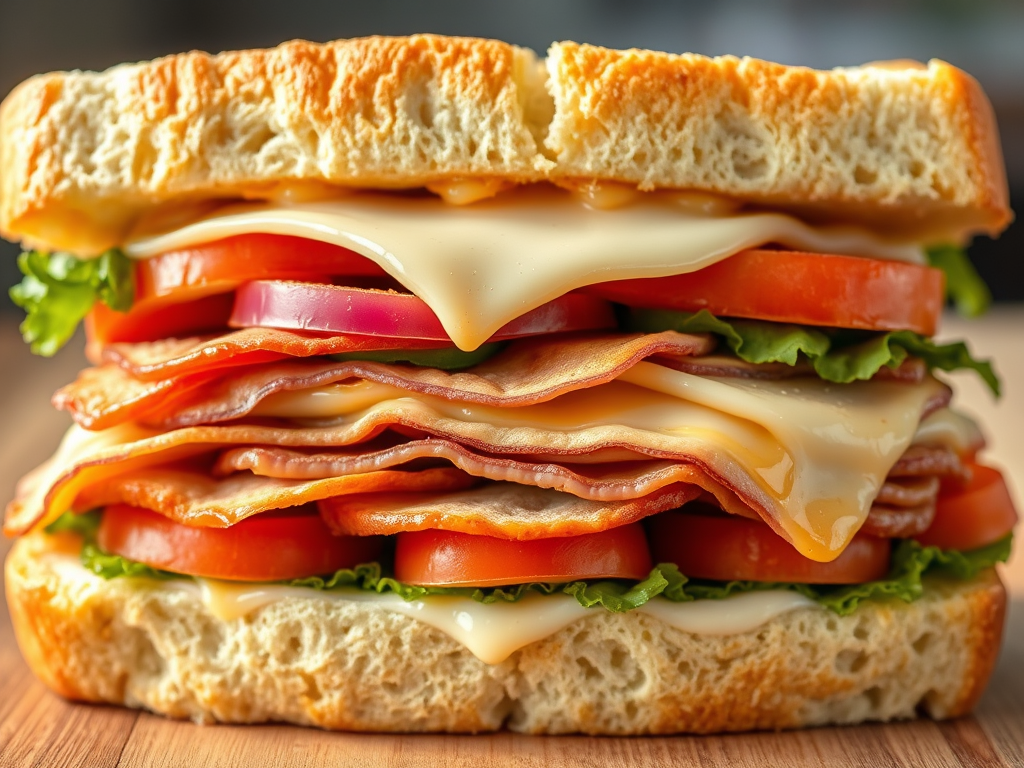
The term “Sandwich Generation” was coined in the early 1980s to refer to younger parents (in their 30s and 40s1) who take care of not only their children, but also an aging parent. Miller, D. (1981). “The ‘Sandwich’ Generation: Adult Children of the Aging.” Social Work 26:419–423. When I hear that term, I think of a very neat sandwich, bread on top and bottom holding the layers of cold cuts, lettuce, tomato, mayonnaise and cheese in neat layers. The kids and parents are obviously the bread, and the caregiver apparently is the internal goodies — but what the heck holds it all together?
The Pew Research Center estimated in 2013 that “Nearly half (47%) of adults in their 40s and 50s have a parent age 65 or older and are either raising a young child or financially supporting a grown child (age 18 or older). And about one-in-seven middle-aged adults (15%) is providing financial support to both an aging parent and a child.” https://www.pewresearch.org/social-trends/2013/01/30/the-sandwich-generation/#:~:text=Sandwich%2Dgeneration%20adults%20are%20somewhat,things%20they%20have%20to%20do. Those numbers are only going up as people live longer, adult children stay home longer, and people are waiting longer to have children (meaning many more in these age-brackets have children at home later in life). Updated research found that “about a quarter of U.S. adults (23%) are now part of the so-called “sandwich generation,” according to a Pew Research Center survey conducted in October 2021. These are adults who have a parent age 65 or older and are either raising at least one child younger than 18 or providing financial support to an adult child.” https://www.pewresearch.org/short-reads/2022/04/08/more-than-half-of-americans-in-their-40s-are-sandwiched-between-an-aging-parent-and-their-own-children/ Although there are so many people who are the caregivers in this crazy sandwich, it can feel very lonely.
And on top of it all, “sandwich generation caregivers are also more likely than other caregivers to work for pay (69% vs. 54%).” https://medicine.umich.edu/dept/psychiatry/news/archive/202212/%E2%80%9Csandwich-generation%E2%80%9D-study-shows-challenges-caring-both-kids-aging-parents The emotional toll and exhaustion is real, and it impacts every part of life. We try to hold it all together, but a large percentage of caregivers report having to step back in their career or even quit their job due to the stresses and time commitment of caregiving.2
Not all of us are the traditional 6-inch footlong. I am not. I am in the right age-bracket, and I do have children at home, a 14-year-old son and a 19-year-old daughter in college (college students, for those who don’t know, still require a massive amount of “raising,” despite all of our best intentions). It isn’t my parents who are dependent on me, but my paternal grandmother. My father, although he holds all the actual authority to make decisions, is generally far removed from what my grandmother needs, both in proximity (he lives 1000 miles away) and in general awareness. Like 69% of sandwich generation caregivers, I have a job outside of my home as well. It is a job that I love, but one that comes with its own significant amount of daily stress and pressure.
None of this is organized into a neatly stacked club sandwich. There is no room or distinction between the layers of my life. It is more like an exploding burrito at a Mexican restaurant, overfilled, falling apart, and complete with a side of rice and beans that just runs together with the sauce over the burrito. Who doesn’t love a good mushed up plate of spicy sauce and cheese? I could eat it every day of the week and be pretty happy. But, there are days when it completely overflows the plate. Those are the days when nothing seems to be in order and my family at home is left living with a maniac.
I am keenly aware of my blessings. I have a grandmother who I grew up around, who my kids have been lucky enough to know, who was involved in my life, and who I am able to help in her later life. I would not give that up for anything and do not want struggles with caregiving to change our relationship. Financially we are also fortunate. Grandmother’s first husband, my grandfather whose nickname was Wild Bill, was a planner and a saver. He meticulously planned for their future in advance of his death at a very young age. She is so lucky to be able to support herself in a wonderful place (when she remembers how to write a check) and so my family does not have the added pressure of having to financially provide for her in addition to the emotional and physical strain.
At 92 years old, Grandmother is a member of the Silent Generation. She has instilled the “silent” part in our family. We do not put our crazy on display for the neighborhood. We quietly guard embarrassment or dissent in the house. We act like ladies, calmly pushing down any emotion. My sister and I were raised to be respectful, agreeable, and quiet. We have been taught to defer to our elders (especially in public); we have been taught which fork is used for the salad and how to pour coffee properly into a cup and saucer; and I would not dream of failing to follow an invitation or a gift with a thank you note. The deference to our parents and grandparents means that conversations about different options, or disagreement, are not tolerated, even now that I am an adult. The result, at least for me, is that I tend to “go along to get along,” not wanting to rock the boat – I SUCK at difficult family conversations. This is an interesting dynamic now, when the adults in the room may not be in the best position to chart our course. In many cases, that also has meant that we were taught to bear our struggles alone.
As Grandmother aged, some things stayed exactly the same. She remains intensely confident, independent, and private. I was absolutely floored when I learned that she had been forgetting to pay bills, taking medications erratically or not at all, and forgoing necessary health treatment for months. Had I just missed it for months, or years? How had it gotten this bad? That began my new reality of constant guilt, agonizing over decisions, and splitting my time between my home and hers.
Everything changed for me when I got the phone call from a family friend (the upside of everyone in a small town knowing everything about their neighbors). Grandmother had fallen and was in the hospital. Of course, no phone call from her to ask for help. After getting through my afternoon work, making sure I wasn’t up against any deadlines, and moving the rest to another day, I arrived at the hospital to hear that she was having dizzy spells, blacking out, and falling with some frequency. Yet every doctor who came to see her was told, “I’m just fine. I don’t know why they made me come here.” And God forgive anyone who offers her Jello – those little cups of bright-colored slime are apparently vile, and everyone should know that she will not eat that. (That coming from the woman who I told ONE TIME when I was 8 years old that I liked Ambrosia Salad3 and was then cursed with it at every holiday until she no longer was able to host family dinners!) I sat with her in disbelief – both at the fact that I had somehow been able to ignore her stunning health decline and that she dared throw a public fit about having to eat Jello.
From what I could learn, she had finished her shower, gotten dressed, and was straightening the bathroom – all while having one of her “spells.” The next thing she knew, “I fell into the bathtub! Can you believe that! My nose was right down in the drain when I came to!” She lay on the floor for hours, waiting for a friend who she expected to come by later that day — despite the alert cord hanging right next to the shower that would have alerted the retirement home immediately for help.
“If I pull that cord the ambulance comes. Everyone comes out to see who is ill or dying. I am NOT going to make that kind of scene.”
How the woman did not break a bone, knock all of her teeth out, or even end up with lacerations needing stitches I will never know. “I’m just a lucky person, she replied matter-of-factly. You know, I once won a car on a slot in Vegas!” (A favorite story that has been told for decades). In her mind, some luck at the blackjack table translated into invincibility. But she couldn’t rely on luck to protect her from her decision months ago that she no longer needed to take her blood thinner.
Awesome. Welcome to life in the mess of the sandwich generation. The food is good, but I am sure it will end up all over my white shirt.
- This makes me so happy! I can still say I am a “younger” parent! ↩︎
- https://rosalynncarter.org/wp-content/uploads/2021/09/210140-RCI-National-Surveys-Executive-Summary-Update-9.22.21.pdf; https://press.aarp.org/2024-5-16-US-Workforce-Report-70-Caregivers-Difficulty-Balancing-Career-Caregiving-Responsibilities; https://pmc.ncbi.nlm.nih.gov/articles/PMC9922792/ ↩︎
- For those who are not aware of the Southern delicacy – Ambrosia salad is not a reference to the food of the Gods. It is a disgusting combination of jello, tiny marshmallows, marshmallow fluff, coconut, fruit (often from a can complete with ultra sweetened syrup), and any number of other things. ↩︎

 We Survived:
Leave a comment