This is my confession. I am a terrible caregiver.
I am impatient and anxious to an absolutely ridiculous level. I am more than a little selfish. I have difficulty switching between tasks. And, to top it all off, I am a ball of stress, worrying about every part of my life and assuming the worst will certainly occur in every situation.
The ADHD that I have been able to manage without medication for most of my life has gotten worse in perimenopause. I have turned into something like a perpetually tired squirrel. I am constantly running around, forgetting something every single time I stop. I have, more than one time, started an online purchase, been distracted by an email coming in, gone to ask my daughter about the topic of the email, gotten a phone call, and then, three days later, wondered why the order (which I never completed) hasn’t arrived. I have always described how my brain works to my husband like this: I have 5 ESPN tickers running constantly around my brain. I cannot shut any of them off; they do not change speed or pause; they contain a constant rush of information, at varying levels of emergency. The addition of my grandmother’s rapidly declining health has had the impact of scrambling those usually straight tickers, jumbling up the words. My perfectly organized lists and schedule that usually get me through my days are in chaos. My kids, husband, and grandmother should be afraid – maybe very afraid.

One thing I have going for me is that I am quick to admit these faults. I am learning to laugh, often through tears, at things that end up completely wrong. But, I will never stop blaming myself and second-guessing every decision. Before you jump to reassure me that I am doing just fine or that I have to be exaggerating, please just take in the following story.
After realizing that my grandmother’s health was a bit of a mystery to everyone, including her, it was determined that someone should attend some doctor’s appointments with her. I was fairly certain that she had stopped taking her medications reliably about six months before (based on refill dates, the beginning of her more serious health issues, and the amount of medication that was in various pill boxes all over her apartment). It still feels completely overbearing and invasive to attend doctors’ appointments with another grown adult, but luckily she was agreeable and allowed me to accompany her without much objection.
My first trip to the doctor with her was intended to be an appointment with her family practitioner. The office was located five minutes from her retirement home. The plan was to attend a quick check-up and then have dinner at 4:30 (the usual time for dinner in the main dining hall). When I arrived to pick her up, I was pleasantly surprised to find that she remembered the appointment and knew that I was going with her. She immediately pointed out that she was waiting for me, because I was about three minutes late.
The less-pleasant surprise was her sudden belief that she was married to her friend Ollie. My grandmother was married twice, once to the love of her life, my grandfather, and once to a very kind man who made her very happy for more than 30 years. Both men died suddenly, leaving her twice a widow. Neither man was Ollie. With no time to sort out that mess before the doctor’s appointment, I acquiesced to Grandmother’s demand that her “husband” accompany us to the doctor. Neither Ollie nor my grandmother is very steady on their feet, both are terrified of falling, and both use a walker around the retirement home. Neither is willing to leave the retirement home with a walker, however. Instead, they take very deliberate (SLOW) steps. This means it takes more time than I ever plan for to get where you are going. They are both adamant that no one outside of the retirement home see them using a walker.1
Shortly after I arrived, we all loaded into my car and started the quick trip to the doctor’s office. The tiny town where my grandmother lives has two hospitals, the main hospital and the Catholic hospital. We were headed to the Catholic hospital that day. While it is the nicer of the two hospitals, it is still a small hospital in an underserved rural town where many doctors only practice one day a week while spending most of their time in the larger city nearby.
I dropped Grandmother and Ollie at the front entrance of the doctors’ building and watched them shuffle to the main door as I parked the car. Pausing for a minute, I couldn’t help but wonder if they looked like cute old people, holding onto each other heading to the door, or if the scene was instead a very sad one of two old people struggling as they walk into a hospital badly in need of modernization. A somber snapshot that sticks in my mind. It was a passing thought, and I hustled into the building just in time to hear that there was something confused with the appointment.
I had both of them sit down, as neither was really helping at that point anyway, and talked with the extremely kind receptionist. Today’s appointment was not, in fact, with my grandmother’s primary care physician (she could not remember his name), or at the hospital doctor’s building, or a general check-up. Instead, the appointment was with a physician’s assistant, in an office about 15 minutes away, for a cognition test. But since, I was not going to come all this way to see no doctor, the receptionist let the office know we were on our way and we headed for the door. At the time, I was too flustered to really consider the implications of a cognition test or what had brought on the need for the test. I just had to keep moving forward.
On our way out of the hospital building, I was concerned with making sure that my grandmother did not trip or fall. I wasn’t paying attention to Ollie, who was generally a little sturdier on his feet than Grandmother. That was the first of many mistakes that day. As we left through the automatic sliding doors of the hospital, Ollie stumbled and hit his forearm on the door jam. His thin skin had a pretty good gash and blood was soon everywhere. I took one look over my shoulder at Ollie and asked “do you need to go to the ER, it is just one building over.” He shook his head no, and I didn’t question it. I left my grandmother on a bench outside the hospital door and ran into the bathroom to grab some paper towels for Ollie. My patience was already wearing thin and I was not kind as I shoved a stack of paper towels into his hands while I fished a couple of band-aids out of my purse. As Ollie tended to his wounds and my grandmother sat safely on a bench, I got the car. We all loaded into the vehicle, complete with seat belt issues, and headed off to the other office 15 minutes away.
We drove through a neighboring town where my grandparents lived when they were young and first married. My grandmother, seemingly oblivious to the chaos, realized where we were and took a trip down memory lane. She pointed out the little bungalow house that she had shared with my grandfather and told me how much they had loved that house. She saw an abandoned building on the corner that used to be a bar and talked about how they would go dancing there. Meanwhile, I was focused on making it to our appointment.
We pulled into the parking lot of the building and, luckily, there was parking right outside the front door. One of the benefits of a small town. I grabbed my things (and my grandmother’s purse) and made sure both passengers got safely out of the car. I walked in right behind my grandmother, holding the door open into a small poorly-lit waiting room as she passed through. Ollie with his now bandaged arm was behind me, carrying more of my grandmother’s belongings.
Like a scene out of a painfully bad comedy, just as she took a step into the building Grandmother caught her left tennis shoe toe on the slightly elevated door jam. In slow motion, her body tilted forward and she began to fall. I stood there, my mind racing about what to do.
Do I grab her arm to try to stop her fall; or do I grab her around her waist?
She is so frail, would grabbing her result in a broken arm?
Would a broken arm be worse than what might happen if she falls?
It couldn’t be worse than a broken hip, right?
As this ran through my mind, the fall continued and she landed (surprisingly gracefully) on the floor just inside the waiting room on the out-of-date office carpet. Her first reaction was to try jump up to her feet, undoubtedly to end the “scene” and the embarrassment that resulted. But, she was weak, the fall had been a shock, and her efforts to get up were not successful. I convinced her to stay seated on the floor while I quickly let the receptionist know that we had arrived – as if all of this had not already alerted her. A nurse came and helped Grandmother up and into a chair. A fall is my worst nightmare. I do not want to have to call my father, her son, and report that Grandmother was injured in a fall while I watched.
I sat down in a waiting room chair between Ollie and Grandmother and I could feel the eyes of the other patients in the waiting room raising from their months-old magazines and landing on me. It is a small community, and I could already feel the text messages flying around town. The story would eventually get back to my family, probably before this appointment ended. Everyone in the office was likely contemplating whether there is a hotline to report elder abuse. I took a deep breath and sent a text to my husband and my sister.
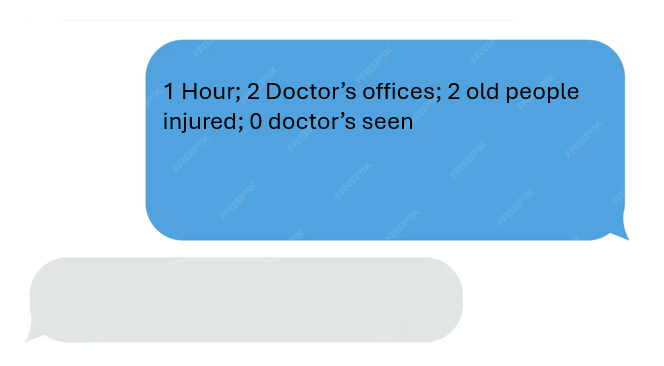
Just as I heard the swoosh of the text being sent, the nurse called us. Leaving Ollie in the waiting room (thank goodness for small blessings), we began the slow journey. I already knew I was in way over my head, and the next three hours confirmed it.
The physician’s assistant couldn’t have been happy to see us coming. I’m sure our 3:30 Friday afternoon appointment was her last of the day and we were late. Plus, it was clear that we needed more than the planned short cognitive test would provide. But, this woman was the first of the many angels on Earth who have helped me during this journey. Despite her understandable frustration, she took a deep breath, looked at me (clearly about to cry), and simply said “well, you all have a lot going on here.”
We started with the brief cognition test. It felt to me like it went on forever. I sat quietly, despite urges to jump in to provide answers while my grandmother struggled through the test. Not even half an hour ago, she was able to tell me about her life decades in the past, but now she could not remember the day, month, or year or even the town she lived in. It was uncomfortable and absolutely heartbreaking. How had it gotten this bad? Should I have noticed sooner?
Although her cognitive difficulties were evident, we only quickly discussed this. We then moved on to her fall risk and overall health, clearly bigger problems that needed to be addressed. The conversation that followed was my first experience with the true state of my grandmothers failing health — and showed why I hadn’t noticed.
PA: Who is here with you today, Mrs. Williams?
Grandmother: [after an extended pause] This is my granddaughter Sally. My husband Ollie is in the waiting room.
I gave only a large exaggerated head shake indicating that no, Ollie is not her husband, and no, my name is not Sally. The PA understood the point and I didn’t have to say anything. I am only her granddaughter, after all. I am too far removed to have any authority here whatsoever, and Grandmother would not take kindly to me speaking over her, contradicting her, or answering in her place.
Q: How are you doing Mrs. Williams?
Grandmother: Fine. I don’t even know why you need to see me.
My brain was racing. I thought, Holy cow, we are here for a reason! You are not fine. You have been struggling. I had to speak up.
Me: Well, you are having some trouble getting around these days, and I know you have had a couple of falls.
PA: Have you had other falls recently?
Grandmother: No.
The PA looked at me and asked about falls. I told her that I know Grandmother has had at least two other falls recently. As the words were coming out of my mouth I already knew Grandmother would not be happy. I felt like I was betraying a trust.
Grandmother: Oh well, i do have spells.
PA: Spells? What do you mean?
Grandmother: Oh, I get pretty dizzy and then I don’t always remember what happens. But they pass. And I haven’t had one for awhile.
This was how it began.
As we discussed doctors and medications, I realized that I was a woefully uniformed caregiver. The PA went through her files and set us up with other appointments. My grandmother claimed to have had a check-up with her cardiologist recently, saying “He told me I was in better health than he is.” I eventually learned that she hadn’t been to the cardiologist for a check up for several years and her pacemaker monitoring had been completely halted when she unplugged the portable monitor. I had brought all the bottles of medications from Grandmother’s apartment with me to the appointment (a clear win), but as I started pulling them out, I noticed they had spots of blood on them from Ollie’s earlier accident.
Three hours later, we had a stack of new prescriptions and a list of upcoming doctors’ appointments that I would have to fit into my schedule. I also had a new list of medical worries and concerns about my grandmother. Was she in denial that her health was failing? Was she purposely lying or hiding the truth? And if she was lying, why would she do that? And, how did I fit into all of this? Was I going to be a welcome help or was I destined to anger my Grandmother with my meddling?
The reality of the situation swirled through my head as we drove back to the retirement home without talking, listening to the car beep incessantly because I was too exhausted to worry about seat belts being fastened.
- My grandmother is also adamant that she does not need the walker at all. It is just a short term protection. However, now she has used the walker around the retirement home for over a year and she clearly needs it. Her belief that she will eventually not need the assistance anymore is clearly false. ↩︎

 We Survived:
Leave a comment