This was not an email I had on my bingo card for this year! Never did I think that the decision to move my grandmother from her independent apartment to assisted living would become gossip – a conspiracy theory – that would cause so much grief and be spread all over town. Now I had to email the director of the retirement home to explain that I had not started these rumors; the story did not come from me!
Earlier this year, my grandmother needed to quickly move within her retirement home from a two-bedroom apartment to assisted living. Her health was at a critical point, and initially she understood the need to make the move. Once her health improved, my grandmother started to believe that she was forced to move into the smaller assisted living apartment not because of her health but because the director of the retirement home “stole the apartment she loved out from under her.” Apparently, her idea was that the director (who has been nothing but compassionate and wonderful to all of us) kicked her out of her two-bedroom apartment and forced her to move to assisted living so they could charge the next renter more money. It was such a detailed theory. It sounded so crazy that it might just be true. And, in reality, it would have been easier on me to tell Grandmother this story, rather than telling her the truth. There was no talking her out of it. And she would talk about it with anyone who would listen. It was devastating to me that she was unable, or unwilling, to accept that the true reason for her move was her declining health. She was simply unable to see that it was the care and kindness of the assisted living staff that helped her health improve.
She returned to the subject of the apartment over and over again, forcing me to go through the entire awful discussion about how she needed to move because she couldn’t manage her medications, was having memory lapses about how to do simple tasks, needed a bit more help with day to day activities, and was having trouble physically getting around. She would then tell me that she was getting along just fine and in fact she just went out to lunch yesterday with a friend – a lunch that may or may not have actually taken place. She would tell me resolutely that she had her own money and was going to buy a new apartment. She even went so far as to look into another two-bedroom apartment in the facility when she heard another resident was moving out of theirs and into assisted living. It was like Groundhog Day.
Grandmother also was completely convinced that in the move someone had stolen her makeup (which she wears only sporadically at this point). This was despite the fact that I showed her at least once every week that all of her makeup was in the bathroom drawers in her new place. Regardless, the next time I was with her, she would again tell me that the last person who lived in this apartment had left a mess, and this must be that person’s stuff. Trying a different approach, I offered to take her out to buy new makeup on multiple occasions, but she always declined. The same was true with her clothes. She was convinced she didn’t have everything that belonged to her, and that some of the clothes in her closet belonged to someone else. She also had not opened the closet, looked at her storage containers, or identified what she had, what she was missing, or what she might need. My stomach was constantly in knots, trying to anticipate her needs, explain decisions that I had made, or make her happy.
Grandmother has moved to a different facility now into a slightly larger assisted living apartment that she chose, and the fixation has shifted to five pieces of furniture. She is now missing one wingback chair and a matching armchair, two traditional (large) gold lamps, and a lamp with a blue and white ceramic dog base. My father relayed my grandmother’s current complaints, asking if I knew anything about these items – as if I wasn’t aware that she was obsessed with the missing furniture. Over and over she tells me that “she is just sick about it” and that she guesses they must have been stolen when they were in storage. The thought of a masked man running away with some antique lamps and a pink wingback chair is a pretty ridiculous image.
The wingback chair and matching striped arm chair were part of her living room for years in her two-story home with her second husband. They were each a part of a matching pair, perfectly coordinated with the wallpaper and floors, but sadly four chairs would not fit in her smaller assisted living space, especially since she needed room to maneuver a walker and a wheelchair. So, after some time in my basement and evaluation of which chairs were in the best shape, the best ones were sent to her new place and the others were donated to charity. The same is true of two lamps with gold bases – of which she had multiple. However, the “dog lamp”? I have never seen anything like what she describes! Every time I speak to her, I feel like I am being accused of stealing from her because I made the difficult decision to donate some items from a very full two bedroom apartment so that she could move into the assisted living that she desperately needed.
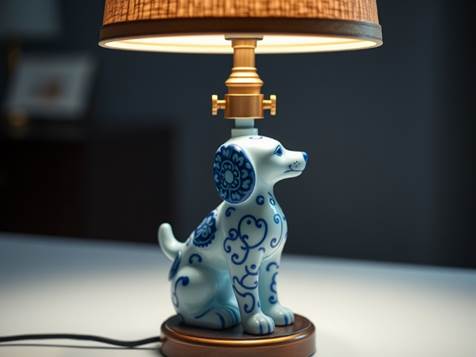
In the beginning I told her that the extra items were stored in my basement because they would not fit in her new place or because we didn’t want certain things to be vulnerable to loss in her assisted living. Once she was settled in and doing better, I went through everything and made donations of things we didn’t think she would be able to use. I assumed that, over time, she would acclimate to her new living arrangement, and this would all fade into the past. Perhaps that was cold of me – I know how important a person’s accumulated things can be to them, and I tried hard to keep most everything with sentimental value. Months later nothing seems to have faded. And now, I don’t have the heart to tell her anything different. Every conversation causes an emotional reaction that I can feel through my entire body – tears, tense muscles, headaches, and nausea. The result in inevitably my trying to replace what I can on eBay – which makes my husband unhappy and did not solve the mystery of this blue dog lamp!
I can only do the best that I can for her. I hope she will eventually understand and forgive me, even if it is from the other side of St. Peter’s gate. In the meantime, I pray for patience and try not to completely lose my mind.
The intellectual part of me knows that fixations/repetitions, hallucinations, and suspicion are not uncommon for an elderly person with dementia. I hear stories from other caregivers of loved ones accusing their caregivers of stealing from them, when really they misplaced an item or it was lost or abandoned years in the past. But, another part of me sometimes believes that in my situation, Grandmother is returning to the subject on purpose, to protest her lack of control and just to let me know that she is still angry with me. I know that my relationship with my grandmother is forever changed. Mourning the loss of a relationship with a person who is still here is a surreal experience.
I have found that these mental ticks come and go. I cannot take any credit for successfully dealing with them. And I have no advice that will make them easier to endure. Sometimes, for me, just knowing I am not alone goes a long way. I typically try to give a brief (repetitive) explanation about the subject of her fixation before redirecting her attention to something else. The explanation for her move started to sound like a broken record, a rehearsed monologue complete with emotion and tears. It was difficult to be patient with her, while not treating her like a child and still protecting myself and others from the frustrations that come with these fixations and accusations. There are resources that discuss strategies to help caregivers deal with fixations. (Try these: https://www.mentalhealth.com/library/tips-for-dealing-with-specific-dementia-behaviors; https://www.nccdp.org/how-to-deal-with-fixation-in-dementia-a-guide-for-caregivers/; https://www.ourparents.com/senior-health/dementia-and-repetition; http://www.caregiver4caregivers.com/FalseAccusations.html). If you need some words of affirmation, or a place to begin looking for more information, a site called Caregiver 4 Caregivers is a quick, easy resource to confirm for yourself that you are not alone in these (and other) struggles (www.caregiver4caregivers.com).

 We Survived:
Leave a comment